
Animal Welfare Board of India and Stray Crisis
Wednesday , 18 March 2026- 5 min. read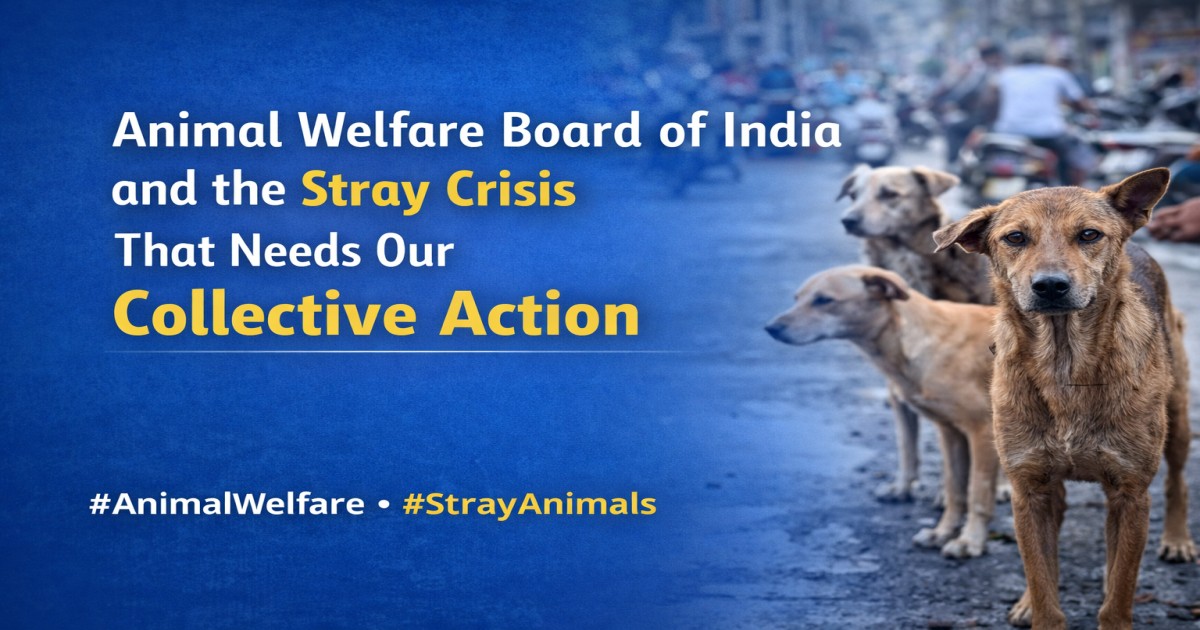
The Animal Welfare Board of India has a mandate that the vast majority of us know nothing about – and this lack of public awareness is a large part of why stray animals in India continue to remain among the country’s most underfunded welfare and public health concerns.
At i2u Social Foundation, we work directly with animal welfare organizations on the ground. The gap that we see consistently is not a gap in solutions; rather, it's a gap in sustained (financial, civic, and political) support for systems that already exist and that already work where they are adequately resourced.
This article aims to outline what is actually going on, what evidence says about interventions that have been shown to be effective, and where support is most desperately needed.
The Numbers Behind Stray Animals in India
The WHO and the Animal Welfare Board of India estimate the country's stray dog population to be 35 million – the highest in the world. These numbers do not even include stray cats, cattle that are dumped after their productive lifespan, or horses no longer needed for their ceremonial use. Taking these animals into account, the total number of animals living without consistent access to food, shelter, and veterinary care comes in at over 60 million.
These figures are the sum total of decades of neglect in solid waste management, responsible pet ownership practices, funding for municipal programs, and enforcement of animal welfare legislation. While no single reason can explain why we have reached this point, and there is no single remedy, we do know what the contributing factors are and the kinds of interventions that are known to work.
Stray Animals in India and the Public Health Reality
About 36% of the world’s rabies deaths occur in India each year – this translates to approximately 20,000 deaths annually, the majority caused by the bites of unvaccinated stray dogs. The population that suffers most is children and outdoor workers – construction workers, farmers, and waste pickers. These individuals often have restricted access to post-exposure treatment and may not be able to afford a complete vaccine course.
There are an estimated 15 million formally reported animal bite cases each year. Numbers from rural areas and those lacking accessible healthcare facilities likely do not make it into the formal count, making the actual number significantly higher.
The welfare status of the animals is equally concerning. Endemic skin conditions are a common problem among stray populations. Diseases, like parvovirus, spread rapidly through unvaccinated young litters. Road traffic accidents account for a large proportion of stray dog deaths in Indian cities; yet, organized emergency response for animals-a service that could truly change these numbers-is widely absent in most urban centres.
These are not naturally occurring conditions. They are the direct result of failures within specific, addressable systems and the gap between policy and practice. And importantly, there is evidence from many Indian cities to suggest that intervention, properly targeted and sustained, can effectively close these gaps.
The Role of the Animal Welfare Board of India
Established under the Prevention of Cruelty to Animals Act of 1960, the Animal Welfare Board of India has a mandate that includes advising on animal welfare policy, overseeing the implementation of the PCA Act, supporting animal welfare organizations, and coordinating the Animal Birth Control program. This program is recognized by the Supreme Court of India on multiple occasions as the sole legally compliant and scientifically sound method for controlling stray dog populations.
The AWBI operates under significant constraints. Its work spans an incredibly complex federal structure involving the central government, states, and municipalities, each with distinct budgets, priorities, and capabilities. Because of the complexity, it takes a considerable effort to gain buy-in and coordination, making progress often incremental-a hallmark of governance on this scale in India.
To us at i2u, two measures would greatly improve the AWBI's ability to fulfill its mandate: First, a national, functional, up-to-date database on ABC surgery volume, stray population estimates by district, vaccination rates, and bite incidence. Currently, usable data simply does not exist. Without reliable data, resource allocation is effectively a guess and assessing the impact of the program is impossible. Second, update the penalties under the Prevention of Cruelty to Animals Act. The maximum fine for cruelty has been set at 50 rupees since 1960. The fine hasn’t been revised, and draft amendments to raise it have been discussed but repeatedly postponed. They are long overdue.
The Animal Birth Control Programme India Needs to Scale
India's national mandated animal birth control program works by sterilizing, vaccinating against rabies, and returning the animals to their existing territories-a method affirmed by the Supreme Court and supported by evidence of its effectiveness in cities that are dedicated to it.
In cities like Mumbai, Jaipur and parts of Bengaluru, where the ABC program has been sustained over a decade or more, stray population stabilization has been achieved. The WHO suggests that 70% sterilization of the female stray population is necessary to impact the rate at which it is increasing, a benchmark most Indian cities are nowhere near. The math is quite simple; an unsterilized female dog has two litters per year and, if sterilization is not widespread, populations do not plateau-they grow. Reducing this gap requires higher surgery volume, effective post-operative care, consistent quality of veterinary care, and municipalities need to support, on a continuous basis, the program they have already signed up to execute, particularly when there is public pressure to switch to quickly implemented measures that have a track record of failure.
Why Stray Populations Stay High: The Structural Factors
The biggest factor that perpetuates stray populations is waste management. Animal populations thrive where food is easily and consistently available. When waste is unmanaged in overflowing landfills or open roadside dumps, it becomes a reliable food source. By improving solid waste management, we can have more impact on reducing stray populations than with direct programs by the Animal Welfare Board of India. It also addresses public health issues like vector-borne diseases and air pollution. The ethical imperative for responsible waste management for animals is essentially the same as the ethical imperative for human health and the environment.
The other major contributor is pet abandonment. India has seen an exponential increase in the number of owned animals in the past decade. These pets are often sourced from unmonitored pet shops or bought from individuals without prior planning on the part of the owner. Changes in circumstance-an unavoidable move, the arrival of a baby, a clearer understanding of the responsibilities of pet ownership-lead to animal abandonment on the streets. In most cities, there is neither mandatory microchipping, an accessible system for formal surrender of unwanted animals, nor legal repercussions for abandonment, which directly adds unvaccinated, unsterilized animals to the population.
What the Evidence Says Actually Works
The Animal Birth Control program, run effectively, funded adequately, and with the necessary controls and post-operative care in place, works. This isn’t a hypothetical proposal-we have seen cities that have effectively utilized it achieve a stabilization of stray dog populations.
Managed feeding groups, when community members are informed and organized to feed animals on a regular basis, reduce human-animal conflict and improve the welfare status of the animals. Fed dogs are usually calmer and healthier. They become early points of contact for veterinarians, help with vaccination drives, and provide better chances of sterilization success. The difference between a formally organized feeding scheme and an ad hoc one is tremendous.
Adoption decreases the street population and does so permanently. However, adoption rates in India lag behind the need for many reasons. Some can be attributed to a pervasive preference for pedigree dogs and a lack of accessible shelters and foster facilities, but these issues are slowly changing thanks to organizations we work with, and they are moving in the right direction, although too slowly for now.
Enforceability of the Prevention of Cruelty to Animals Act needs serious strengthening. It is impossible to meaningfully deter cruelty to animals when the maximum fine remains fixed at 50 rupees. As long as penalties remain obsolete, enforcement remains primarily symbolic, which will have a negative impact on welfare improvement initiatives.
Civil Society Is Filling a Structural Gap
Throughout India, countless individuals and small organizations are operating sterilization camps, running rescues, setting up adoption programs, and initiating community vaccination efforts. They are doing this work because the government bodies tasked with this responsibility at the municipal level are failing to do so on a sufficient scale, and because these animals are suffering and need immediate attention, regardless of official policy.
In many cases, civil society efforts do not supplement government actions; instead, they fill an entire systemic void. The organizations working on the ground typically do so with extremely limited budgets relative to the sheer scale of the challenges they face.
Our objective at i2u Social Foundation is to bridge the gap between caring individuals who wish to contribute and the organizations doing the vital work. Whether it’s identifying a trusted local organization, sponsoring a sterilization camp, or supporting a specific rescue effort, the process should be simple. That is exactly what i2u Social Foundation was created to do.
How to Contribute
- Sponsor a sterilization: You can fully fund the ABC sterilization for an animal through many reputable organizations, making it one of the most cost-effective means of making a tangible difference in this space.
- Foster: While adoption is the ideal end goal for every animal, temporary fostering can ease the burden on shelters and rescue organizations, socialize the animals for adoption, and directly improve their chances of finding a permanent home.
- Report cruelty under the Prevention of Cruelty to Animals Act. While only Section 11 clearly identifies what constitutes cruelty to animals, persistent, documented reporting can help build evidence for a legal case against offenders and strengthen enforcement, an action severely hampered by low numbers of reports currently.
- Redirect CSR funding to the ABC program. Funds under Schedule VII of the Companies Act may be eligible for CSR and are perpetually underutilized compared to the actual need, especially considering the availability of corporate giving funds.
- Advocate at the municipal level. Pushing for a dedicated budget line item in your local city budget for the ABC program is a concrete, actionable goal that local advocacy can achieve.
The Animal Welfare Board of India is vested with the legal mandate. The Prevention of Cruelty to Animals Act, 1960, provides the framework. India’s animal birth control program has court backing and verifiable scientific evidence supporting its efficacy. The organizations on the ground have the necessary knowledge and drive to do this work. What the current situation requires now is sustained, scaled support-whether in terms of financial resources, civic engagement, or the continued public scrutiny that holds institutions accountable to the mandates they already hold.
Stray animals in India are not an insurmountable problem. They are a problem of insufficient funding and support. The gulf between the status quo and a vastly improved future is very real, and it is certainly bridgeable through carefully channeled, focused support.
.png)
.jpeg)

.png)
.png)