
World Autism Awareness Day: The Need for Support Systems
Thursday , 02 April 2026- 5 min. read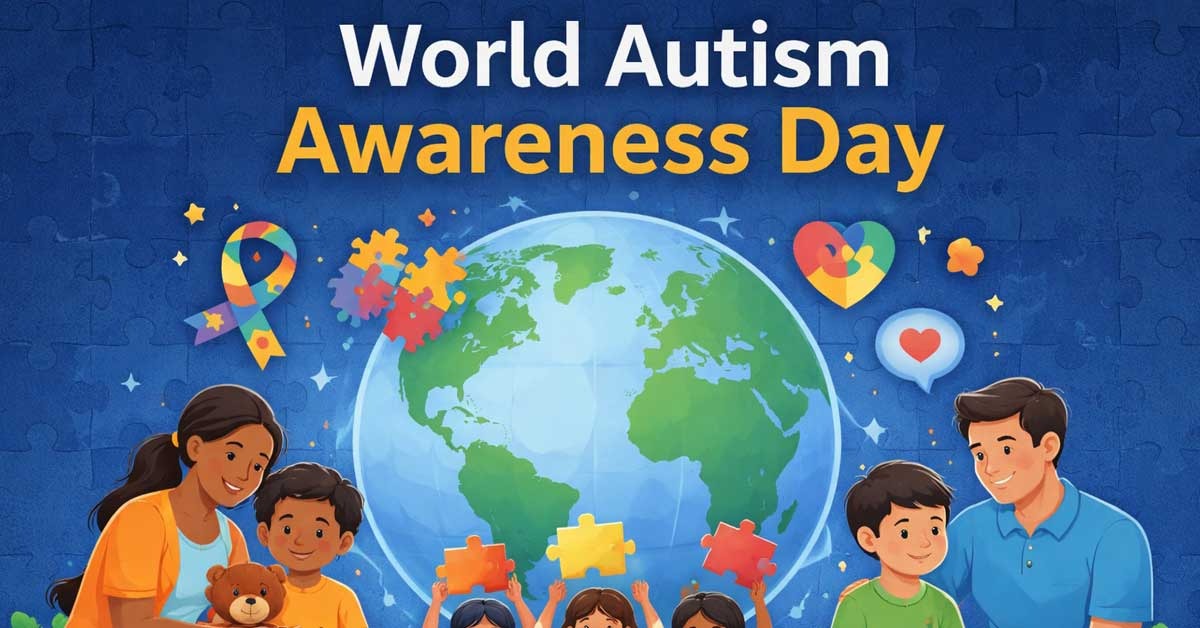
April 2 is World Autism Awareness Day, designated by the United Nations General Assembly in 2007. The purpose was to, and still is, build worldwide awareness about autism spectrum disorder, demystify misinformation and stigma, and serve as a call for policy response. Almost two decades later, awareness has grown by leaps and bounds. But that awareness is not deep enough. And in India, that gap between awareness and the ability to respond is much wider.
This blog covers what autism is, describes what the Indian story specifically looks like in tangible terms, and highlights where systems and society fall short.
What Is Autism Spectrum Disorder?
The most common and well-known condition, and the one most people would be familiar with, is Autism Spectrum Disorder or ASD. A neurodevelopmental disorder. A neurodevelopmental disorder is a disorder that affects the development of the nervous system, especially when that development occurs before birth.
The word spectrum is often misunderstood as a range, a little afflicted at one end, completely at the other, and back again. That's not what it is. The spectrum is a testament to how wide the range is within autism. Two people with autism can be so far apart in their skills, the support they need, their experiences, communication, and more that their diagnosis can be practically irrelevant to the outsider.
If I told you one of these people may not communicate at all, may have to be supported to dress or eat every day, and may feel the world physically and emotionally too much and need to sit outside to access it, how many of you would assume the other was the same? The other might have a nine-to-five job, be living independently, and receive a diagnosis in adulthood, after years of painfully developing social skills and coping mechanisms - ‘masking’ - as clinicians euphemistically call it. Both are autistic. Neither is more nor less.
The Diagnosis of Autism: When to Look for Autism Spectrum Signs
The signs usually appear between ages 2 and 3, but late diagnosis, especially in women and girls, is increasingly recognized as a worldwide clinical concern; girls and women often show less obvious signs and at a later age.
Another thing that needs to be repeated in 2025: vaccines don't cause autism. The article in 1998 that suggested a connection was withdrawn and its author sacked following inquiries into research misbehaviour. Follow-up studies in many countries involving billions of children show no link. Still, the rumour persists. It shouldn't.
The Indian Context: What the Data - and the Gaps - Tell Us
There is no national database in India with information on autism. This in itself is a significant data point.
Prevalence estimates, such as 1 in 68 children, are often cited from international sources, but their direct application in India remains difficult due to several factors, including challenges in diagnosis.
The National Trust for Welfare of Persons with Autism, Cerebral Palsy, Mental Retardation and Multiple Disabilities functions under the Ministry of Social Justice and Empowerment and was established in 1999. Different schemes of the government have been put in place at different points in time to help support families, provide funds for early intervention, and expand coverage. The institutional architecture is also in place, at least in principle.
It's where the services fall apart: implementation. Trained clinicians, developmental paediatricians, speech-language pathologists with specific autism experience, and occupational therapists are concentrated overwhelmingly in a very limited number of metropolitan areas. Families in the rest of the country, and indeed in many small towns and rural districts, say they are lucky if the initial diagnosis itself doesn't take a six-hour drive, several days of waiting, and thousands of rupees, followed by a report and very little discussion about what that report might mean, let alone how to act on it.
There is another methodological problem that is rarely acknowledged by the mass media. Autism diagnostic tools, created for Western, English-speaking clinical pathways, are applied in a nation with 22 scheduled languages and hundreds of dialects spread across vast and diverse cultures, where sociolinguistic norms for eye contact, socio-emotional responses, and the description of social phenomena vary widely and are conceptualized in different ways, giving questionable validity to the diagnosis.
Persistent Myths That Have Real Consequences
Children don't grow out of autism.
They do not. Autistic children become autistic adults. Support needs evolve over a lifetime. They don't end at 18 years. The lack of up-to-date services and support for autistic adults remains stark in India, compared to the scarcity that exists for autistic children. In most of the country, autism-specific health and community support, employment services, and mental health care don't exist for autistic people who reach adulthood.
Every autistic person has an exceptional ability in one domain of their life.
According to the film industry, this is the story everyone is increasingly willing to tell - Rain Man, My Name Is Khan, and lately many foreign productions. These domain-specific extraordinary abilities, sometimes called savant skills, are present in a proportion of autistic people, but they are not a universal or essential aspect of autism. Expecting them can hinder the lives of many autistic people rather than help them.
Non-speaking means non-understanding.
A very harmful assumption, and one that is much more well-documented. There are many forms of Augmentative and Alternative Communication (AAC), from a picture board to a speech-generating device, that can enable a non-speaking person to communicate. A large proportion of non-speaking autistic people have shown, through access to sufficient and appropriate forms of communication, understanding, preferences, and engagement in intellectual activity. The linking of speech with thought has meant that a lot of people have had to wait for appropriate forms of support.
Therapy should focus on making autistic individuals seem neurotypical.
The clinical consensus on this has changed quite a lot over the years, partly due to research and partly due to the efforts of autistic adults who have experienced older behavioural methods firsthand and have documented the damage caused. The support provided is geared toward quality of life, communication, and acquiring the skills you need - not hiding the characteristics that reveal your autism to others.
What Substantive Support Looks Like
Early detection is still very important - not so much because diagnosis must somehow have a quick response, but because actually referring families for support before anger and distress escalate really can make a visible difference to outcomes. That may be speech therapy, OT, communication aids and - actually - information. Families are often given a diagnosis, but there's no guidance about what it is.
Inclusive education is the law. The official law governing inclusive education is the Rights of Persons with Disabilities Act, 2016. In reality, inclusive education is unevenly available. A child put into a mainstream classroom but given neither adapted material nor support in the classroom from a teacher trained in special education is not experiencing inclusion; they are having exposure, but not access. True inclusive education needs structural investment: in teacher training, in adapted pedagogy, and in a school culture that doesn't see neurodevelopmental difference as a problem to be overcome but as a reason to adapt.
In the corporate world in India, employment for autistic adults has just started garnering attention and is still limited to the technological sector and a few other sectors that have directly taken on this cause. Several organisations were working on this issue even before it gained the recognition that it has today. Prominent among them are V-Excel Educational Trust, Ummeed Child Development Centre, and Muskaan.
Finally, the issue of support for caregivers is consistently missed in our discussions. Mothers bear the brunt of primary caregiving in India, and the systems that support caregivers, such as peer groups, mental health services, and respite services, do not exist in any significant magnitude. Caregiver exhaustion must be taken as a system failure and not as a failure of the caregiver or modern care practices.
A Note on Language
As a result, the language used to describe autism has changed over time and continues to do so. Amongst many autistic people, and within a large or even majority portion of the autistic self-advocacy movement, autistic person is preferred, because autism is not separate or secondary to the individual, but is itself an aspect of who they are.
Terminology like "high-functioning" and "low-functioning" is now better understood as clinically inaccurate description and practically irrelevant labels. Functioning labels refer more to how successfully someone appears neurotypical rather than how much difficulty they encounter or what support structures are necessary. Someone labeled high-functioning could be experiencing very high levels of internal anguish, and someone labeled low-functioning could have equal ability that is completely masked by speech barriers. Neither description is particularly relevant.
What World Autism Awareness Day Should Actually Prompt
India Is Us aims at the individual, institutional, and systemic levels in the domains of welfare, social impact, and community development. We see aspects of autism at this level as being around systems, diagnostic access, educational infrastructure, employment channels, and caregiver strength and support systems - all of which have tangible gaps in India.
World Autism Awareness Day holds meaning only if it leads to action. If it encourages a parent to finally seek the referral they’ve been postponing, that matters. If a school genuinely reviews what its equity and inclusion policy looks like in practice, that matters. If organisations acknowledge that neurodiversity hiring cannot remain a token gesture and must be meaningfully supported, that matters.
The puzzle piece, which has been used as a symbol of autism for a very long time, has been challenged by many autistic people who see it as suggesting some sort of deficiency. Many autistic communities have now adopted the infinity symbol instead, symbolising neurodiversity. It's a small change. What it hints at on a much bigger scale is a fundamental contrast: raising awareness of autistic people, versus hearing and listening to them.
.png)
.png)
.jpeg)