
Beyond CSR Spending: Are We Investing Where India Needs It Most?
Thursday , 09 July 2026- 5 min. read
Key Takeaways
- India's CSR challenge is no longer just about how much companies spend. It is increasingly about where and how that money is allocated.
- The Ministry of Corporate Affairs' CSR data shows that more than 90% of CSR spending is concentrated in the top 15 recipient states.
- Maharashtra was the largest recipient of CSR funding in FY 2024–25, receiving more than ₹6,000 crore in the state-wise data analysed here.
- CSR spending is also concentrated by sector, with education and healthcare receiving more than half of CSR expenditure over time.
- Geographic concentration does not automatically mean poor allocation. However, it creates an important question: does CSR follow development need, or does it primarily follow corporate and industrial geography?
- Better CSR allocation requires companies to compare development need, existing funding and implementation gaps before selecting projects.
- The future of effective CSR in India should focus on need-adjusted allocation, district-level analysis, additionality, coordination and measurable outcomes.
Is India's CSR spending going where it is needed most?
Not enough evidence exists to say that India's CSR spending consistently follows development need.
The available data shows that CSR spending is highly concentrated geographically and sectorally. More than 90% of CSR expenditure is concentrated in the top 15 recipient states, while education and healthcare receive a substantial share of total spending. Ministry of Corporate Affairs data also makes it clear that CSR funding is not evenly distributed across India.
This does not mean that highly funded states are receiving unnecessary investment.
Nor does it mean that CSR should be distributed equally.
The more important question is whether CSR allocation is based on:
- Development need
- Geographic deprivation
- Existing funding gaps
- Population vulnerability
- Measurable outcomes
or whether it is influenced primarily by:
- Corporate headquarters
- Industrial concentration
- Business operations
- Existing NGO networks
India's CSR system is large enough that this question now deserves serious attention.
The CSR Question India Needs to Ask Next
For years, the central CSR question was:
Are companies spending their mandated CSR funds?
That question was necessary when India's CSR framework was still evolving.
Today, another question is becoming more important:
Are we investing where India needs the money most?
India's CSR ecosystem has become a significant source of social investment. The Ministry of Corporate Affairs has reported more than ₹1.44 lakh crore in CSR expenditure over the five financial years from 2019–20 to 2023–24.
The latest complete state-wise CSR allocation data for FY 2024–25 reveals a highly uneven distribution of corporate social investment.
This does not indicate failure.
But it does indicate a need for a different kind of analysis.
The next phase of CSR should focus not only on:
How much was spent?
but also:
Where was it spent, what problem did it address and what gap did it fill?
How Is CSR Spending Distributed Across India?
India's CSR spending is heavily concentrated in a limited number of states.
The Ministry of Corporate Affairs' Corporate Data Management system notes that more than 90% of CSR expenditure is concentrated in the top 15 recipient states.
The latest state-wise FY 2024–25 CSR data shows substantial differences between states.
Among the largest recipients were:
|
State |
CSR expenditure |
|
Maharashtra |
₹6,065.95 crore |
|
Gujarat |
₹2,707.54 crore |
|
Karnataka |
₹2,254.88 crore |
|
Tamil Nadu |
₹1,968.76 crore |
|
Delhi |
₹1,949.95 crore |
|
Uttar Pradesh |
₹1,545.01 crore |
|
Odisha |
₹1,389.39 crore |
|
Rajasthan |
₹1,145.67 crore |
|
Andhra Pradesh |
₹1,129.75 crore |
|
Telangana |
₹1,054.92 crore |
At the other end of the distribution:
|
State |
CSR expenditure |
|
Tripura |
₹9.45 crore |
|
Mizoram |
₹4.48 crore |
|
Nagaland |
₹15.41 crore |
|
Meghalaya |
₹30.94 crore |
|
Arunachal Pradesh |
₹39.57 crore |
The differences are substantial.
But the numbers require interpretation.
Does higher CSR spending mean a state is overfunded?
No.
A state receiving more CSR does not automatically mean it receives more than it needs.
Maharashtra, for example, has:
- India's largest concentration of companies
- Major industrial centres
- A large population
- Significant urban and rural inequality
- Tribal and geographically underserved communities
The problem is therefore not simply that Maharashtra receives more money.
The problem is that aggregate state-level figures do not reveal whether CSR funding reaches the communities with the greatest need.
That is why state-level CSR analysis should be only the starting point.
Does CSR Spending Follow Corporate Geography?
The data suggests that corporate geography may significantly influence where CSR money goes.
Several of India's largest CSR recipients are also major economic and corporate centres, including:
- Maharashtra
- Gujarat
- Karnataka
- Tamil Nadu
- Delhi
- Telangana
This relationship is not surprising.
Corporate activity naturally creates:
- More eligible CSR companies
- More corporate foundations
- More local business operations
- More established implementation partners
- More relationships with local organisations
This can create a structural tendency for CSR funding to follow the geography of companies.
The development needs of India, however, are not necessarily distributed according to the same geography.
This creates an important risk:
Areas with fewer large companies may have less access to corporate social investment, regardless of their development needs.
The Ministry of Corporate Affairs' own CSR infrastructure has increasingly recognised the importance of improving information and coordination around CSR allocation.
The question is not whether companies should stop investing near their operations.
They should not.
Local communities affected by business operations are legitimate CSR priorities.
The question is whether a company's entire CSR portfolio should be determined by where it operates.
A stronger approach is to balance:
Local responsibility
Investment in communities connected to business operations.
High-need geographies
Investment in locations with significant unmet development needs.
Strategic priorities
Investment in problems where corporate funding can provide additional value.
Maharashtra Received More Than ₹6,000 Crore. What Does That Tell Us?
The latest state-wise data shows:
- Maharashtra: ₹6,065.95 crore
- Bihar: ₹260.53 crore
Maharashtra therefore received more than 23 times as much CSR funding as Bihar.
This comparison should not be used to conclude that Maharashtra is overfunded.
That would be analytically weak.
Maharashtra and Bihar differ significantly in:
- Economic structure
- Corporate concentration
- Population
- Industrial activity
- Development conditions
The comparison does, however, demonstrate why CSR spending must be analysed against need rather than expenditure alone.
The latest multidimensional poverty estimates show that India has made substantial progress, with multidimensional poverty declining to 11.28% in 2022–23. Approximately 24.8 crore people are estimated to have exited multidimensional poverty between 2013–14 and 2022–23.
However, deprivation remains unevenly distributed.
Some states contain significantly larger populations experiencing multidimensional deprivation.
This leads to a more useful question:
How much CSR funding reaches high-need populations relative to the scale of need?
India does not yet routinely evaluate CSR using this framework.
It should.
Why State-Level CSR Data Is Not Enough
A state can receive significant CSR funding while high-need districts remain underserved.
This is one of the biggest limitations of analysing CSR at the state level.
Maharashtra is a useful example.
Mumbai and Pune have very different development conditions from districts such as:
- Nandurbar
- Gadchiroli
- Palghar
- Washim
The same is true across India.
Uttar Pradesh is not one development geography.
Neither are:
- Rajasthan
- Madhya Pradesh
- Odisha
- Karnataka
- Bihar
- West Bengal
State-level totals cannot answer:
- Which districts received CSR funding?
- Which communities benefited?
- How much reached rural areas?
- How much reached tribal populations?
- Where were projects concentrated?
- Which high-need districts received little investment?
This is why India's CSR analysis needs to move towards:
District-level and need-adjusted allocation.
The Ministry of Corporate Affairs already provides CSR information across states, sectors and other dimensions.
The next step is to connect this spending data with evidence of development need.
Which Sectors Receive the Most CSR Funding in India?
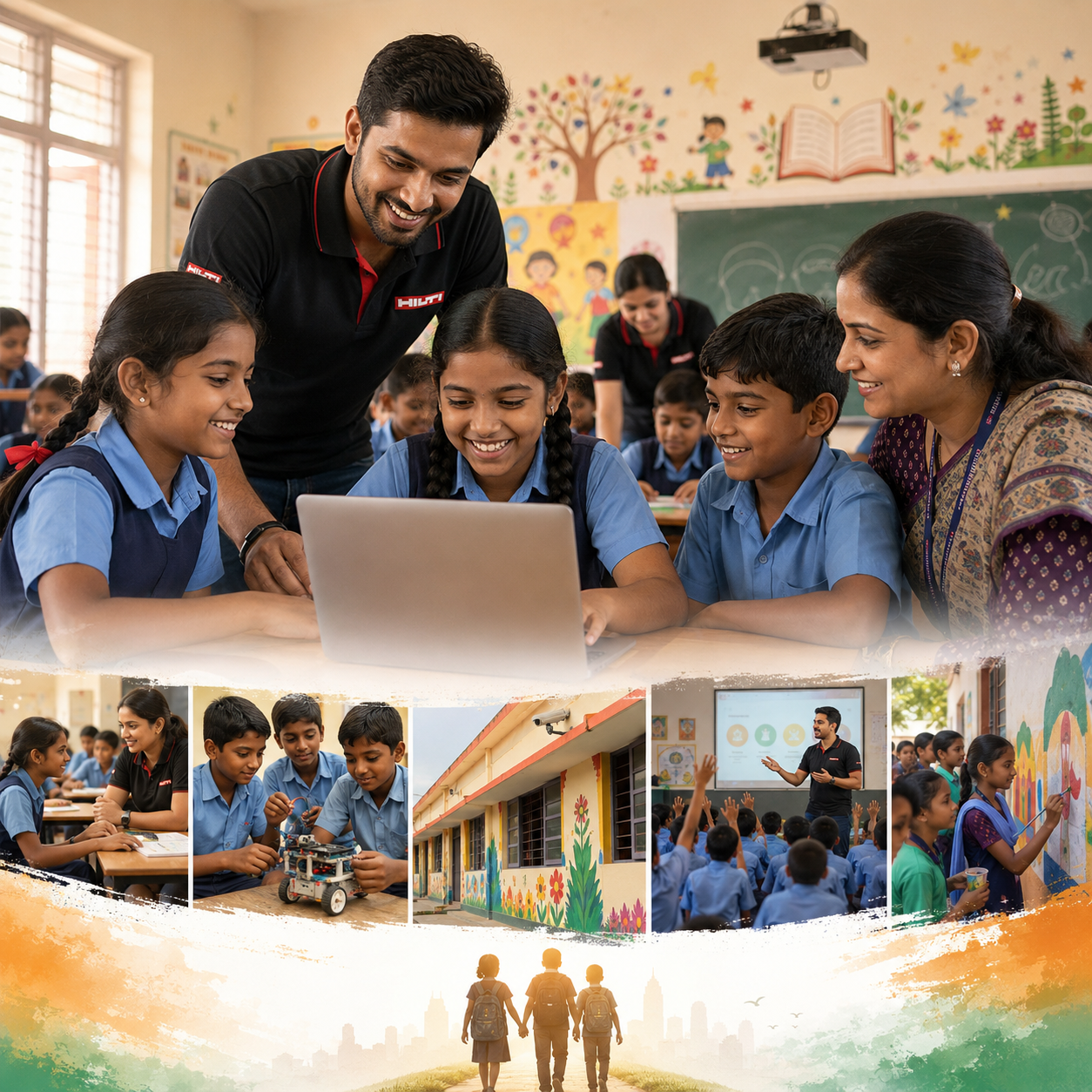
Education and healthcare are India's two largest CSR priority areas.
The Ministry of Corporate Affairs' development-sector analysis shows that education and healthcare have consistently been priority sectors and together account for more than 51% of CSR spending over time.
Other major CSR areas include:
- Rural development
- Livelihood enhancement
- Poverty-related interventions
- Hunger and malnutrition
- Environmental sustainability
Education and healthcare are essential development priorities.
The question is not whether companies should fund them.
They should.
The problem is that these categories are too broad to function as complete investment strategies.
Why “Education” Is Not a CSR Strategy
A company may say:
Education is one of our CSR priorities.
But education is not a single problem.
The latest UDISE+ 2025–26 data shows that India's education system includes:
- 14.67 lakh schools
- 1.02 crore teachers
- 24.72 crore students
India's education challenge is therefore not simply about building more schools.
Different locations have different needs.
One district may require:
- Better infrastructure
Another may require:
- Functional sanitation
Another may require:
- Electricity
Another may require:
- Digital access
Another may require:
- Teacher support
Another may require:
- Student retention
Another may require:
- Improved learning outcomes
All of these fall under "education."
But they require different interventions.
A broad sector preference does not tell a company what it should fund.
A stronger CSR strategy asks:
What specific education problem exists in this geography?
Then:
What evidence demonstrates that this problem requires intervention?
Only after answering these questions should a project be designed.
What Does the Latest Education Data Mean for CSR?
India's education system has expanded significantly.
The latest UDISE+ data records more than one crore teachers.
That means CSR strategies should move beyond outdated assumptions that India's education challenge is uniformly about a shortage of schools and teachers.
The next generation of education-focused CSR should focus on identifying specific gaps.
For example:
- Where are infrastructure gaps concentrated?
- Which schools lack essential facilities?
- Where are students leaving school?
- Which populations face exclusion?
- Where are learning outcomes weak?
- Where does technology solve a genuine problem?
The important principle is:
The intervention should follow the evidence—not the popularity of the intervention.
A smart classroom may be useful.
A device distribution programme may be useful.
A school infrastructure programme may be useful.
But none of these should be selected simply because they are familiar CSR projects.
What Does the Latest Health Data Mean for CSR?
India's health needs are becoming more complex.
NFHS-6, covering 2023–24, provides the latest major national household survey evidence on India's health and social development indicators.
The survey covered 715 districts, making district-level evidence increasingly important for planning health interventions.
India continues to deal with:
- Maternal and child health challenges
- Nutrition
- Unequal healthcare access
while also experiencing growing concerns related to:
- Overweight and obesity
- Metabolic risks
- Non-communicable diseases
This means "healthcare" is also too broad to function as a complete CSR strategy.
A company cannot simply decide:
We will invest in healthcare.
It needs to ask:
- Which health problem?
- Which population?
- Which geography?
- What evidence supports the intervention?
- What is already being funded?
Why CSR Healthcare Needs to Move Beyond Medical Camps
Medical camps can be valuable.
So can:
- Hospital equipment
- Ambulances
- Screening programmes
- Healthcare infrastructure
But India's changing health profile requires a broader approach.
Many health challenges require:
- Prevention
- Early identification
- Behaviour change
- Long-term management
- Community awareness
A short-term intervention may therefore be less useful than a sustained programme.
The right CSR intervention depends on the problem.
For example:
A district with limited access to diagnostic services may require one approach.
A community facing high non-communicable disease risks may require another.
A population with poor healthcare access may require something entirely different.
The lesson is simple:
Healthcare spending should follow health evidence.
Why Current Data Matters in CSR Planning
One of the most important lessons from NFHS-6 is that evidence must be interpreted carefully.
The latest NFHS-6 fact sheets did not publish new comparable anaemia estimates.
The Ministry of Health and Family Welfare subsequently indicated that anaemia measurement would be supported by an independent ICMR survey using a gold-standard method.
This has an important implication for CSR.
Companies should not continue using old statistics simply because those statistics are familiar.
A responsible evidence-based strategy must ask:
- Is this the most current evidence?
- Is the indicator still measured in the same way?
- Can this data be compared with previous estimates?
- Does national data answer the local question?
Sometimes it will not.
And that means a company may need local research before investing.
Are Popular CSR Sectors Receiving Too Much Attention?
The problem is not that popular sectors receive funding. The problem is whether other important needs are being overlooked.
Education and healthcare receive significant CSR attention.
That makes sense.
However, highly visible sectors can create a risk.
Some development needs are easier to explain and communicate than others.
A company can easily show:
- A building
- A classroom
- A medical device
- A plantation drive
It is more difficult to communicate the value of:
- NGO capacity building
- Monitoring systems
- Community institutions
- Behaviour change
- Data infrastructure
- Governance
- Long-term prevention
This creates a potential visibility bias.
What is easiest to photograph is not necessarily what is most important to fund.
CSR should therefore maintain a balance between:
Direct interventions
Providing immediate services or benefits.
and:
System strengthening
Improving the ability of institutions and communities to create sustained outcomes.
India needs both.
Are We Funding Projects Without Funding the Systems Behind Them?
Many social programmes depend on strong implementation organisations.
However, project-based funding often pays for:
- Activities
- Field staff
- Materials
- Programme delivery
while providing limited support for:
- Data systems
- Monitoring
- Technology
- Governance
- Organisational development
- Staff capacity
This can create an important contradiction.
Funders expect organisations to demonstrate:
- Accountability
- Strong governance
- Reliable data
- Scalability
But these capabilities require resources.
CSR strategies should therefore recognise the difference between:
Funding a programme
and:
Funding the capability required to deliver programmes effectively.
Both may be necessary to create sustained impact.
What Is Additionality in CSR?
Additionality means identifying what happens because of CSR investment that would not have happened otherwise.
This should become one of the most important concepts in CSR strategy.
Before funding a project, companies should ask:
What additional value are we creating?
Suppose a district already has:
- Government programmes
- Multiple NGOs
- Other CSR projects
A new intervention may still be valuable.
But the company needs to identify the gap.
CSR can create additional value by:
- Reaching excluded communities
- Supporting underserved locations
- Testing innovative approaches
- Improving implementation
- Building institutional capacity
- Supporting better measurement
This is where corporate social investment can complement government spending.
CSR is relatively small compared with public expenditure.
It cannot replace government systems.
But it can provide:
- Flexibility
- Innovation
- Risk-taking
- Pilot funding
- Rapid experimentation
The strongest development model is therefore not:
Government versus CSR.
It is:
Government + CSR + civil society + communities.
How Should Companies Decide Where to Invest Their CSR Funds?
A better CSR investment process starts with need rather than projects.
Step 1: Identify the geography
Where are we considering an investment?
Step 2: Identify the development problem
What does the available data show?
Step 3: Identify the affected population
Who is experiencing the problem?
Step 4: Map existing investment
What are government, NGOs and other companies already doing?
Step 5: Identify the gap
What remains unaddressed?
Step 6: Select the intervention
Only after understanding the gap should the company decide what to fund.
The process should be:
Need → Existing Response → Gap → Intervention
Not:
Project → Location → Beneficiaries
This shift could significantly improve CSR allocation.
How Can Companies Identify CSR Funding Gaps?
Companies should compare two types of information.
Map 1: Development Need
Depending on the issue, this could include:
For health
NFHS-6 and relevant district-level indicators.
For education
UDISE+ 2025–26 and other education evidence.
For poverty
Multidimensional poverty and deprivation indicators.
For local development
State and district-level data.
Map 2: Existing Funding
Companies should then examine:
- Government expenditure
- Existing CSR programmes
- Philanthropic investment
- NGO activity
- Available services
The key question is:
Where is there high need but insufficient support?
That is where CSR can potentially create the greatest additional value.
What Happens When Need and Funding Do Not Match?
There are four possible scenarios.
1. High need + high funding
The problem may require:
- Better coordination
- Reduced duplication
- Improved implementation
2. High need + low funding
This may represent a significant investment opportunity.
3. Low need + high funding
Companies should examine whether funding is being influenced primarily by corporate geography or other factors.
4. High need + substantial public spending but poor outcomes
The problem may be an implementation gap rather than a funding gap.
CSR should not use the same solution in every scenario.
That is why diagnosis must come before intervention.
Why District-Level CSR Analysis Is the Next Frontier
A state-level figure cannot show whether CSR reaches the people who need it most.
India's next CSR data challenge should therefore be:
How much CSR reaches high-need districts?
Eventually, companies and policymakers should be able to examine:
- CSR expenditure by district
- Development indicators by district
- CSR expenditure relative to population
- CSR expenditure relative to deprivation
- Sector-specific investment gaps
This would make a much more useful question possible:
Which high-need districts receive the least corporate social investment?
That would be significantly more meaningful than simply ranking states by total CSR expenditure.
Why “Beneficiaries Reached” Is Not Enough
A programme may report:
100,000 beneficiaries reached.
But that does not necessarily indicate impact.
A stronger evaluation asks:
Outputs
What did we deliver?
For example:
- Schools supported
- Students trained
- Communities reached
Outcomes
What changed?
For example:
- Improved learning
- Better health behaviour
- Higher retention
- Increased income
Equity
Who benefited?
Did the intervention reach:
- Vulnerable populations?
- Remote communities?
- Excluded groups?
Sustainability
Will the benefits continue?
Additionality
Would the outcome have occurred without CSR investment?
The final question is difficult.
It is also one of the most important.
Should CSR Projects Receive Multi-Year Funding?
Yes, where the problem requires sustained intervention.
Many development outcomes cannot be achieved within a single financial year.
This includes:
- Learning improvement
- Livelihood development
- Preventive health
- Behaviour change
- Community institution building
Short-term funding can create:
- Programme disruption
- Staff turnover
- Uncertainty
- Weak measurement
A stronger approach is:
Long-Term Commitment + Annual Accountability + Adaptive Learning
Companies should establish:
- A baseline
- Clear outcomes
- Annual milestones
- Regular monitoring
They should also be willing to change programmes when evidence shows that something is not working.
The objective is not permanent funding.
It is giving effective interventions enough time to produce meaningful outcomes.
What Should India Measure About CSR Next?
India already has significant information about CSR expenditure.
The next stage should focus on allocation quality.
India should increasingly measure:
- The proportion of CSR reaching high-need districts
- CSR expenditure relative to development need
- Geographic concentration
- Sector concentration
- Funding duplication
- Outcome quality
- Additionality
- Sustainability
This would change the CSR conversation.
Instead of asking:
How much did we spend?
India could increasingly ask:
What development gap did we close?
Are We Investing Where India Needs It Most? The Answer
The available evidence does not support a simple yes or no.
India's CSR ecosystem is funding important work.
Companies are investing substantial resources in:
- Education
- Healthcare
- Rural development
- Livelihoods
- Environmental sustainability
- Other development priorities
However, the available CSR data also shows:
- Significant geographic concentration
- Significant sector concentration
- Large differences in funding between states
More than 90% of CSR expenditure is concentrated in the top 15 recipient states.
This does not prove that CSR is being poorly allocated.
But it demonstrates why expenditure alone cannot be used to evaluate allocation quality.
A better evaluation would consider:
- Development need
- Existing funding
- Geographic vulnerability
- Population
- Implementation gaps
- Measurable outcomes
India has increasingly detailed development and CSR data.
The next challenge is using those datasets together.
Beyond CSR Spending: The Next Phase of Corporate Social Investment
India's first CSR challenge was compliance.
The next challenge is allocation intelligence.
Companies should increasingly ask:
Are we solving the right problem?
Are we investing in the right geography?
Is there a genuine funding gap?
What is already being done?
What additional value can we create?
These questions distinguish:
Spending CSR money
from:
Deploying social capital strategically.
India has already built one of the world's most significant CSR ecosystems.
The next objective should not simply be to increase spending.
It should be to improve the quality of decisions behind that spending.
A 10-Question Framework for Better CSR Decisions
Before approving a major CSR investment, companies should ask:
1. What specific problem are we solving?
2. What is the strongest available evidence?
3. Which population is most affected?
4. Where is the problem most severe?
5. What is already being done?
6. What funding or implementation gap remains?
7. Why is CSR the right source of support?
8. Who has the capability to implement the solution?
9. What outcome will define success?
10. What happens when the funding ends?
If these questions cannot be answered clearly, a company may have a project idea.
It may not yet have an investment strategy.
The Bottom Line
India's CSR ecosystem has moved beyond the question of whether companies are spending.
The more important question is now:
Are they allocating capital intelligently?
The available data shows a large CSR ecosystem with:
- Significant geographic concentration
- Strong sector preferences
- Major differences in funding between states
That is not evidence of failure.
But it is evidence that India needs a more sophisticated way of evaluating CSR.
The strongest CSR strategies will increasingly be those that can demonstrate:
A genuine need was identified.
A meaningful funding or implementation gap existed.
The intervention was appropriate to the problem.
The investment created measurable additional value.
That is the future of CSR.
Not simply spending more.
Investing with greater precision.
Frequently Asked Questions
What is the biggest challenge facing CSR in India?
One of the biggest emerging challenges is allocation quality. As CSR spending grows, companies need to assess whether funding is reaching high-need populations, addressing genuine gaps and avoiding duplication.
Is CSR spending concentrated in certain Indian states?
Yes. Ministry of Corporate Affairs data indicates that more than 90% of CSR expenditure is concentrated in the top 15 recipient states.
Which sectors receive the most CSR funding in India?
Education and healthcare are consistently among the largest CSR sectors and together account for more than half of CSR expenditure over time.
Does high CSR spending mean a state is receiving too much funding?
No. Total CSR expenditure alone cannot determine whether a state is overfunded or underfunded. Allocation should also be assessed against development need, population, existing government expenditure and local funding gaps.
Why should CSR be analysed at the district level?
States contain significant internal differences. A state can receive substantial CSR funding while high-need districts or vulnerable communities within that state receive limited investment.
What is need-based CSR allocation?
Need-based CSR allocation means using evidence of development need—such as health, education, poverty or infrastructure indicators—to help determine where investment could create the greatest additional value.
What is additionality in CSR?
Additionality refers to the value created by CSR that would not have occurred without the investment. It helps companies assess whether they are filling a genuine gap rather than duplicating existing work.
How can companies avoid duplicating CSR investments?
Companies should map existing government programmes, CSR projects, philanthropic funding and NGO activity before designing an intervention.
What is the best way to measure CSR impact?
CSR impact should be measured beyond beneficiaries reached. Companies should examine outputs, outcomes, equity, sustainability and additionality.
What should companies consider before selecting a CSR project?
Companies should first identify the problem, geography, affected population, existing interventions and remaining gap. The project should be selected only after this analysis.
.png)
.png)
.jpeg)